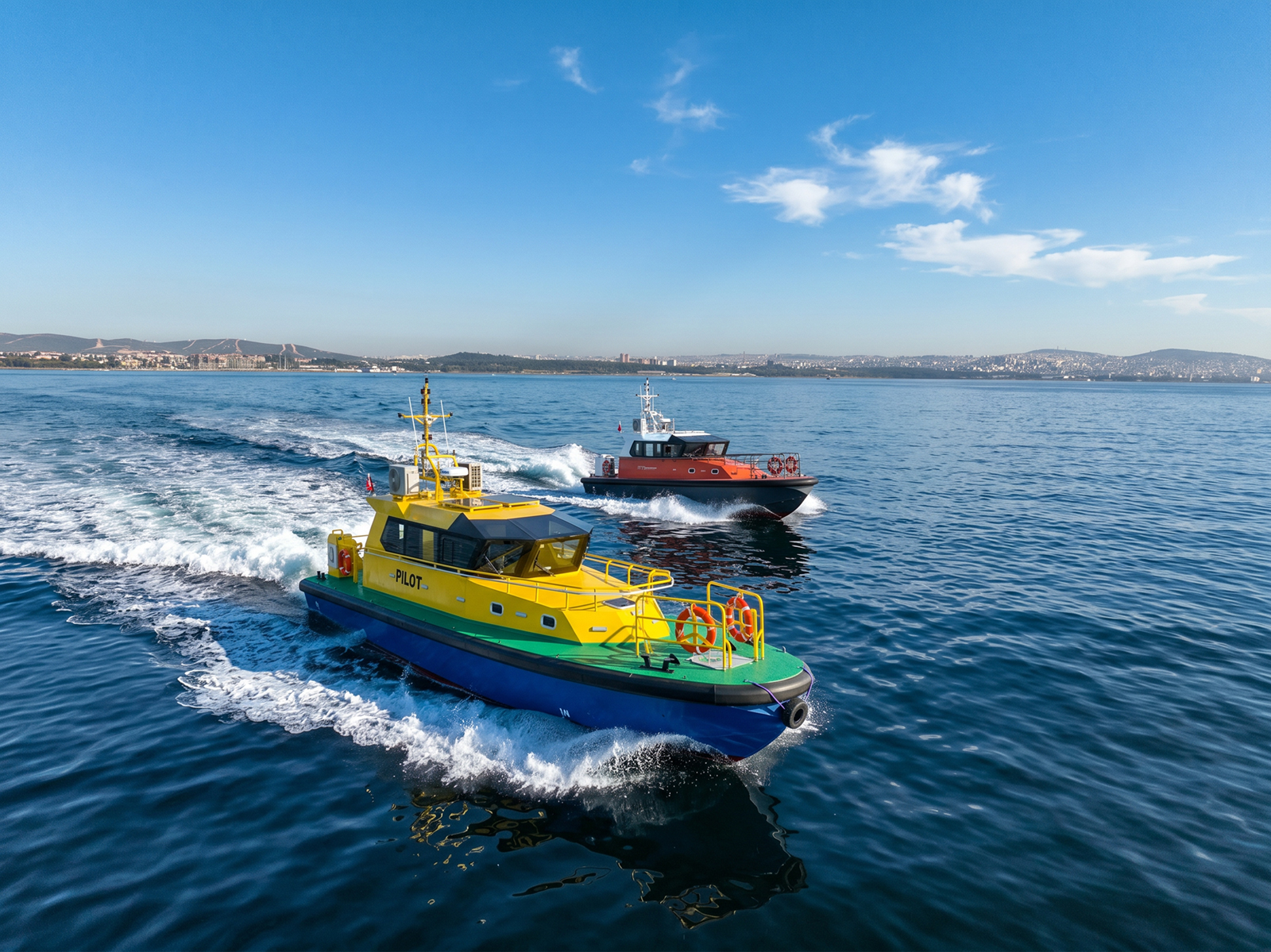
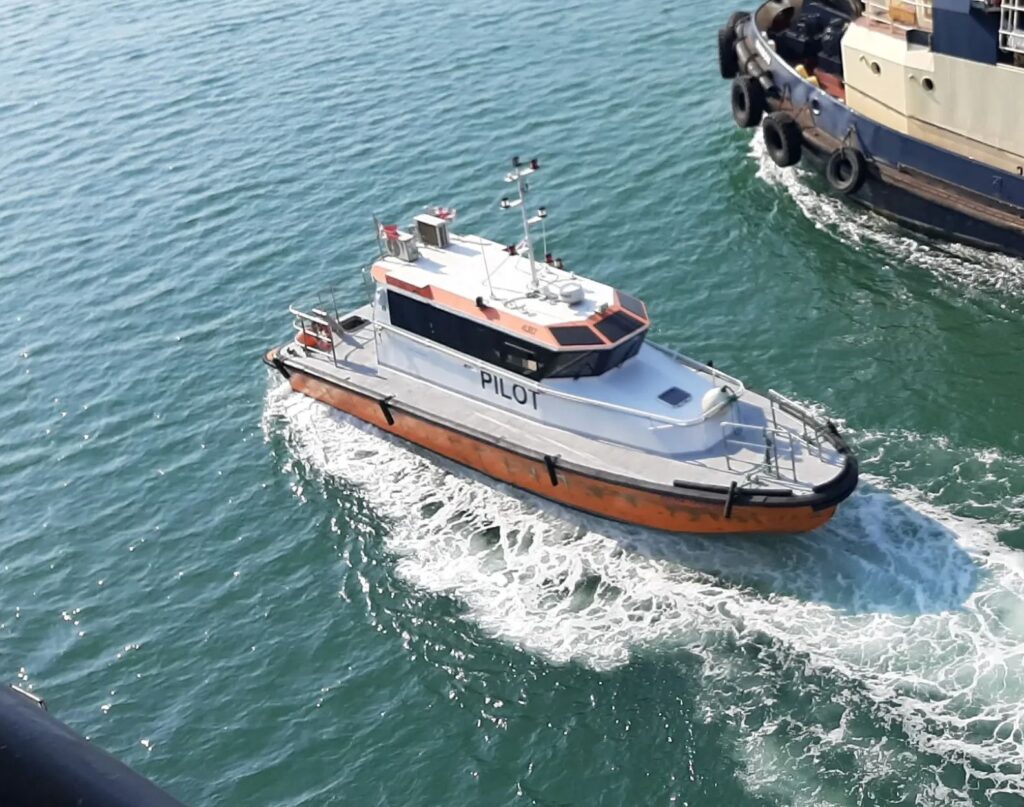
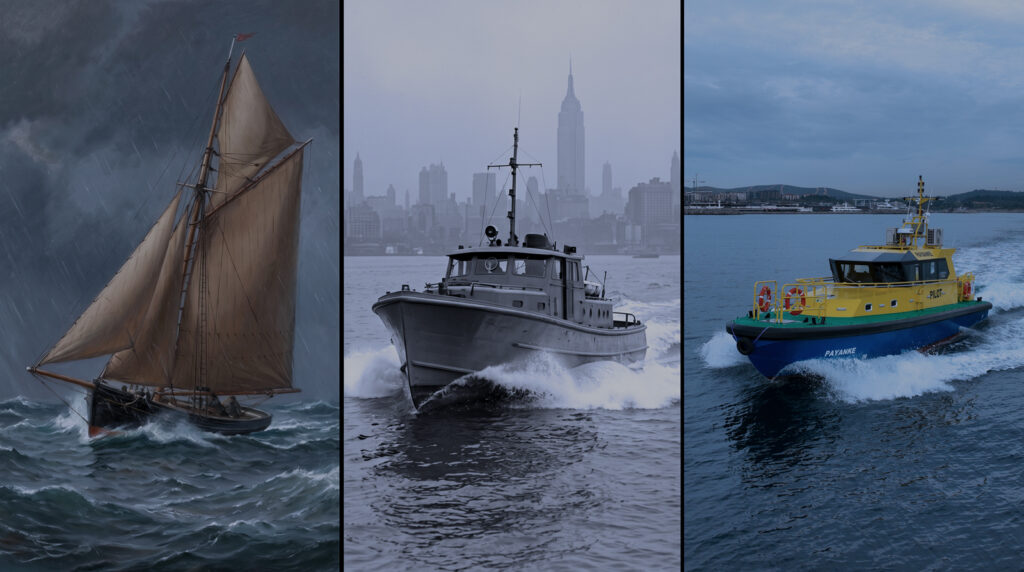
Two vessel types that appear regularly in port and offshore environments often get confused by those outside the industry: pilot boats and crew boats. They share some visual similarities — both are relatively fast, purpose-built workboats operating in commercial maritime settings — but their operational roles, design requirements, and performance specifications are fundamentally different.
Understanding that difference matters for port authorities, fleet operators, and anyone procuring vessels for commercial marine operations.
WHAT A PILOT BOAT DOES
A pilot boat has one primary function: transferring maritime pilots to and from vessels entering or leaving port. This sounds straightforward. In practice, it is one of the most demanding operational profiles in commercial maritime.
The transfer happens regardless of weather. Pilot boats operate in conditions — sea states, wind, swell, restricted visibility — that would keep other small craft in harbour. The pilot must board a moving ship, climbing a rope ladder on the vessel’s hull while the pilot boat holds station alongside. The boat must manage its position precisely in conditions where a misjudgement has serious consequences.
Design priorities for pilot boats follow directly from this role:
Seakeeping above all else. A pilot boat must maintain a stable, predictable motion in rough water. Hull form, weight distribution, and reserve buoyancy are all engineered around this requirement. Speed is secondary to the ability to hold a safe position alongside a large vessel in a seaway.
Self-righting capability. Many classification societies require pilot boats to be self-righting — able to recover from a full capsize. This requirement shapes hull geometry and superstructure design significantly.
Crew protection. The crew of a pilot boat are exposed to spray, impact, and significant motion. Enclosed wheelhouses, shock-mitigation seating, and robust handrails are standard.
Fendering. Repeated contact with the hulls of large vessels is normal operational use. Pilot boats carry substantial fendering systems designed for this contact, not just incidental collision protection.
WHAT A CREW BOAT DOES
A crew boat — also called a crew transfer vessel (CTV) in offshore contexts — moves personnel between shore bases or supply vessels and offshore installations. Wind farms, oil platforms, aquaculture sites, and offshore construction projects all use crew transfer craft.
The operational environment is different from pilot transfer in important ways. Personnel are typically seated inside an enclosed cabin for the transit. The vessel approaches a fixed installation rather than a moving ship. Transit distances are often longer — sometimes 30 to 60 nautical miles offshore — meaning fuel efficiency and crew comfort over extended periods matter significantly.
Design priorities for crew boats reflect this:
Speed and range. Crew boats are typically faster than pilot boats and carry more fuel. Getting personnel on site efficiently and returning them at the end of a shift is the economic driver.
Passenger capacity. Where a pilot boat carries 4–6 crew, a crew transfer vessel may carry 12 to 24 passengers in addition to its operating crew. Seating, safety equipment, and interior layout are designed around this.
Gangway and transfer systems. Modern crew transfer vessels operating at offshore wind installations use purpose-designed bow transfer systems — often a motion-compensating gangway — to move personnel safely from a moving vessel to a fixed platform.
Comfort on passage. Personnel spending 60 to 90 minutes each way on a crew boat need a stable, comfortable ride. Sea-sickness, fatigue, and discomfort reduce operational effectiveness. Naval architecture for crew boats pays significant attention to motion comfort across the sea states typical of the operating area.
KEY DIFFERENCES AT A GLANCE
Pilot boats are built around one high-risk transfer: a single person boarding a moving ship in any weather, with no margin for error. Everything about the design serves that moment.
Crew boats are built around efficiency and capacity: moving groups of people reliably over distance, with comfort and schedule reliability as primary operational metrics.
Hull form differs accordingly. Pilot boats tend to be heavier, more buoyant, with fuller sections that resist capsize. Crew boats tend toward lighter, faster hull forms optimised for speed and range in the expected sea conditions of their operating area.
Both vessel types require purpose-built engineering. Neither is well served by adapting a leisure or general-purpose design to the role.
PROCUREMENT CONSIDERATIONS
For port authorities and maritime administrations procuring pilot boats, the key parameters are: self-righting certification, fendering specification, pilot ladder access arrangements, and the ability to operate in the maximum sea state the port requires.
For offshore operators procuring crew transfer vessels, the key parameters are: passenger capacity, range, transfer system specification, and motion comfort data for the operating area.
Loyd Shipyard engineers both vessel types to client-specific operational requirements. Whether the brief is a pilot boat for a major container terminal or a crew transfer vessel for an offshore energy installation, the starting point is always the operational profile — not a catalogue specification.
Contact Loyd Shipyard to discuss your vessel requirements.
Loyd Shipyard is based in Tuzla, Istanbul. We design and build purpose-engineered workboats for commercial maritime operations worldwide.