The propulsion market for harbour and escort tugs has expanded considerably over the past two decades. Azimuth stern drives, controllable pitch propellers, cycloidal systems — the options available to operators and naval architects have multiplied. Against this backdrop, fixed pitch propellers operating inside fixed nozzles remain the configuration of choice for a significant proportion of the world’s working tugs. That choice is not conservatism. It is engineering logic.
At Loyd Shipyard, FPP-in-nozzle is our standard propulsion configuration for tug builds. This article explains why.
THE NOZZLE: WHAT IT ACTUALLY DOES
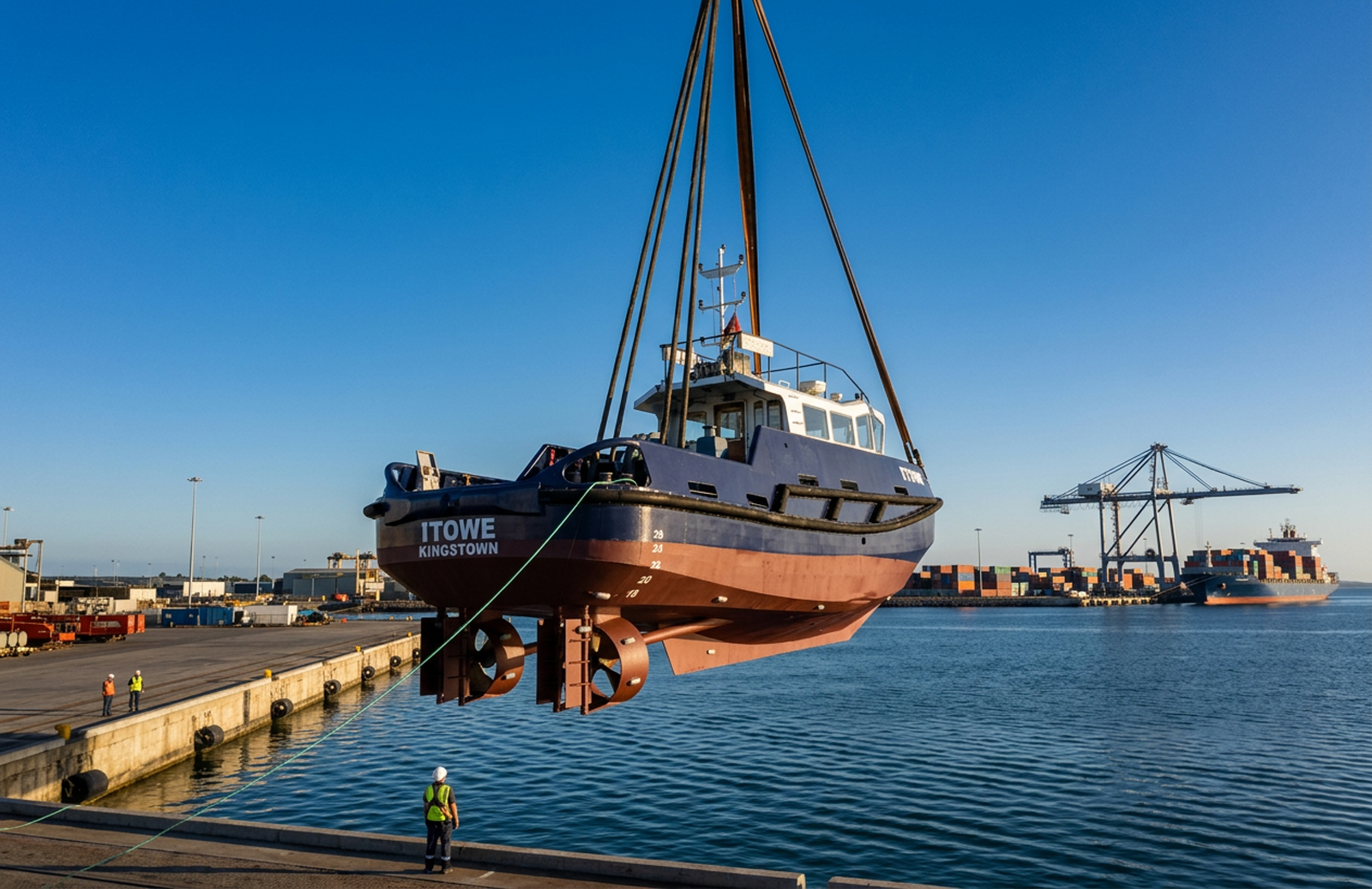
A propeller nozzle — also called a Kort nozzle after its originator — is a ring-shaped duct fitted around a propeller. The nozzle accelerates water flow into the propeller disc and controls the outflow, increasing thrust efficiency particularly at low vessel speeds and high load conditions.
For tugs, which operate almost entirely in the low-speed, high-thrust regime, this is exactly the right environment for nozzle efficiency gains. A nozzle-equipped tug generates substantially more bollard pull per unit of installed power than an open propeller arrangement. Figures of 15–25% improvement in bollard pull are well-documented in the technical literature for accelerating nozzle designs at typical tug operating speeds.
The physics are straightforward: the nozzle reduces tip vortex losses, increases the mass flow through the propeller disc, and recovers energy from the propeller outflow. At bollard pull conditions — the tug’s primary performance metric — these effects are maximised.
WHY FIXED PITCH, NOT CONTROLLABLE PITCH
Controllable pitch propellers (CPP) offer the ability to change blade angle under power, allowing speed and thrust to be varied without changing engine RPM or reversing shaft rotation. For some vessel types, this flexibility is genuinely valuable.
For tugs, the trade-offs are less favourable.
Mechanical complexity. A CPP hub contains the hydraulic actuation system that changes blade pitch. This adds components, seals, hydraulic circuits, and potential failure modes to the most critical part of the propulsion system. A tug that loses pitch control during an assisted berthing or escort operation faces a serious situation.
Hub diameter. The CPP hub must accommodate the pitch-change mechanism. This results in a larger hub diameter relative to the propeller disc area — reducing the effective disc area available for thrust generation and affecting efficiency.
Nozzle compatibility. High-efficiency nozzle designs are optimised around specific propeller geometry. The larger hub and different blade root geometry of a CPP can compromise the hydrodynamic match between propeller and nozzle, reducing the efficiency gains the nozzle is designed to deliver.
Maintenance. CPP systems require specialised maintenance, hydraulic system monitoring, and periodic overhaul of the pitch change mechanism. In port environments where tugs operate continuously with minimal layup time, maintenance burden is a real operational cost.
A fixed pitch propeller eliminates all of these considerations. The propeller is a solid, simple component with no moving parts beyond its rotation. It is matched to a nozzle geometry optimised for that specific blade form and diameter. The result is a propulsion unit that is highly efficient at the operating condition it is designed for, and mechanically straightforward to maintain.
THE EFFICIENCY CASE IN PRACTICE
Tug operations are almost entirely bollard pull and low-speed manoeuvring. The vessel spends very little time at transit speeds where variable pitch might offer efficiency advantages. The operating envelope is narrow and well-defined.
FPP-in-nozzle is optimised precisely for this envelope. The propeller is pitched to match the engine’s torque curve at the load point where the tug actually operates. The nozzle amplifies thrust at that condition. The result is maximum bollard pull from available installed power — which is the primary commercial and operational metric for a working tug.
Fuel consumption at bollard pull conditions is also competitive. Because the propeller is correctly pitched for the load, the engine operates near its design point, and mechanical losses through the drivetrain are minimised.
THE RELIABILITY ARGUMENT
A harbour tug is not a vessel that gets to choose its operating conditions. When a 300-metre container ship requires assistance in a 30-knot crosswind, the tug goes to work. Reliability under those conditions is non-negotiable.
FPP-in-nozzle systems have a multi-decade operational track record in exactly these conditions. The failure modes are understood, maintenance intervals are well-established, and repair can be carried out in most commercial ports worldwide without specialist equipment or proprietary parts.
This matters. A CPP failure in a remote or developing-market port may mean waiting for specialist hydraulic parts or a manufacturer’s service engineer. An FPP failure is typically addressed by any competent marine engineering workshop.
WHEN OTHER SYSTEMS MAKE SENSE
This is not a universal argument. Azimuth thruster systems — Z-drives — offer full 360-degree thrust vectoring and are the right choice for tractor tugs and applications where extreme manoeuvrability is the primary requirement. For certain harbour configurations and escort tug roles, azimuth systems offer capabilities that FPP-in-nozzle cannot match.
The case for FPP-in-nozzle is strongest for conventional shaft-drive tugs where maximum bollard pull, operational reliability, and low lifecycle maintenance cost are the governing requirements. For a significant proportion of the world’s tug applications, that describes the brief exactly.